
![]() |
|
|||||||||||||||||||||||||||||
|
The story so far: a brief introduction to the site and the project This is a brief introduction to Whitehall Villa: you can find more information and more photographs about almost every aspect elsewhere on this web site. This introduction could have several dozen hyperlinks, but I've decided not to include them - you can find your own way around the site using the links in the column on the left. To follow up our finds, go to the Material Culture area of the site. Whitehall Farm lies about 70 miles North of London, on the A5 trunk road. The A5 closely follows the route of the Roman Watling Street which ran from London to Holyhead in Wales. The nearest Roman towns on Watling Street were Lactodorum (Towcester) about 8 miles south, and Bannaventa (Whilton Lodge) about 3 miles to the north. The nearest village is Nether Heyford to the East. This area of West Northamptonshire is rich in Romano-British archaeology. The villa site itself stands on a hillside with a beautiful panoramic view eastwards over the upper valley of the River Nene.
This is a classic English midlands agricultural landscape, with mixed arable and livestock farming in fields marked by ancient hedgerows. In the foreground, at the bottom of the hill, runs the late-18th century Grand Union canal. In the distance are glimpses of the M1 motorway and Northampton. Between the villa site and the A5 runs the main west coast railway line from London to Birmingham and points North. The main archaeological site includes (in roughly historical order) two roundhouses, a proto-villa, a late romano-british villa, a bath house (and probably a second bath house), all, except the proto-villa, within a ditch and bank enclosure of about 2 hectares. This site was continuously occupied for at least 500 years. Elsewhere on the farm we have excavated a 7th century saxon cemetery. The geophysical survey revealed an early 2nd century AD mixed farming landscape based on stone round houses with accompanying rectangular enclosures and inland field system. The villa and bath house were built and re-built during the early 3rd to late 4th centuries AD. The villa was a typical, medium sized, two-storey corridor villa with a large wing at the western end - there was almost certainly an east wing too, but we have not found conclusive evidence of it yet. Most of the foundations of the main villa range have been robbed out. The two roundhouses we have found stood at each end of the villa - that is, the villa was built between them. The northern round house has been completely robbed out, and some of its stones were probably re-used in the bath house. The southern round house is still not completely excavated: at present we have found a substantial stretch of foundation and pottery dating to the 2nd century AD. To the east of the villa is a large paved surface surrounded by a gravel courtyard. This is where the burned-out post holes of the post-roman timber-framed building have been identified. The site has produced just one burial so far, found underneath the level of the courtyard.
The bath house still has standing walls up to eight courses high, and is a very impressive sight with its stoke house and hypocaust still clearly visible. It was re-modelled several times (possibly becoming a dwelling at a late stage) and poses many puzzles. Why is it so large? Why are the stones at the bottom end so massive? How was the water supply managed? But we know quite a lot about the way it was drained and cleansed by water from a spring. One room of the bath house had a "sealed context" - an area of continuously wet soil containing a huge number of environmental finds preserved by the water including seeds, pollen and over 5,000 wild animal bones. We have also found brooches, rings, many pot sherds and fragments of 20 to 30 glass vessels (mainly from the Rhineland), including pieces of a 4th century conical beaker engraved with the figure of a gladiator - a very rare find! There were also hundreds of pieces of late 3rd to early 4th century wood - Whitehall is one of only a handful of sites in the UK to have a collection of roman wood. The finds and data from "room 3b" of our bath house could prove of national importance.
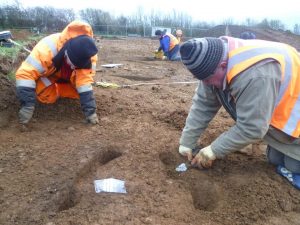
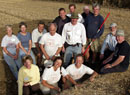
During the 2004 excavation we found evidence for another romano-british building to the East of the villa, further down the hill: in 2005 we found that it had a hypocaust and a range of rooms: the 2006 dig opened uo more of the "new" building, but it is still not clear what function it served. Future excavations will aim to answer the remaining questions about what is becoming a complex site. Up to and including 2005, the site has been run as an "open area excavation": it has been covered over with straw bales and plastic sheeting each winter, and the whole of it's area has been completely weeded and cleaned each year to allow new developments to be seen in the context of the site as a whole. (The exception is the proto-villa area in a field adjacent to the main site - this was closed at the end of the 2002). In 2006, the villa range was not weeded and cleaned. But the bath house was, so that a "virtual walkthrough" could be photographed. The site was found in 1996 by metal detectorists - fieldwalking, geophysical surveys and preliminary excavations followed soon afterwards. The site has been the subject of a major annual excavation each year since 2000. The first three of these digs were training excavations providing archaeology students with structured field work experience to help them to qualify. Students from many UK universities attended: others travelled from the USA, Canada, Japan and Australia to take part. But volunteers, mainly local, have always made up the bulk of the workforce: basic training is given in field archaeology skills and finds processing, and many volunteers have become experienced and skilled in many aspects of archaeological practice. The Director of Archaeology is Stephen Young, a Senior Lecturer at the University of Northampton. The Whitehall Farm Roman Villa and Landscape Project is run by Nick Adams, the farmer who owns the site, Stephen Young and Kate Weaver, and has been funded by grants from various local bodies, including the South Northamptonshire District Council, by donations, and by the proceeds of Open Days held at the end of the annual digs between 2000 and 2003. The Project has also benefitted from sponsorship in kind by several businesses and organisations. In 2005 Whitehall villa was proud to be selected as one of only nine projects nationwide to be featured in the Time Team's "Big Roman Dig" TV series made for Channel 4 and broadcast in July. The daily 'weblog' reports written for C4 were also posted on this site with extra photos. They give you some of the flavour of the 2005 excavation. Whitehall villa is just one of many sites in the area being studied by CLASP (Community Landscape and Archaeology Survey Project) with which the Whitehall Project is closely associated. CLASP has its own website, including detailed reports of fieldwork. Please note that the site at Whitehall Farm is not visible from the road and can be reached only by crossing private farmland: it is not open to the public. But site visits can be made by special arrangement during the digging season. We hope you enjoy finding out more about Whitehall Villa by exploring this site. |
|||||||||||||||||||||||||||||
|
||||||||||||||||||||||||||||||